The Deliverable D2.1 -
Report of the on-field analysis is completed!
We proudly present the first public report of EduCATIA's activities: the consortium has just completed the fundamental 300-pages report on the on-field analysis of AI usage in higher education. The consortium's thorough and competent research of the statistical responses, focus group interview and the degree pragrammes of Kazakhstan and Uzbekistan provide exciting findings and solid basis for further steps of the project.
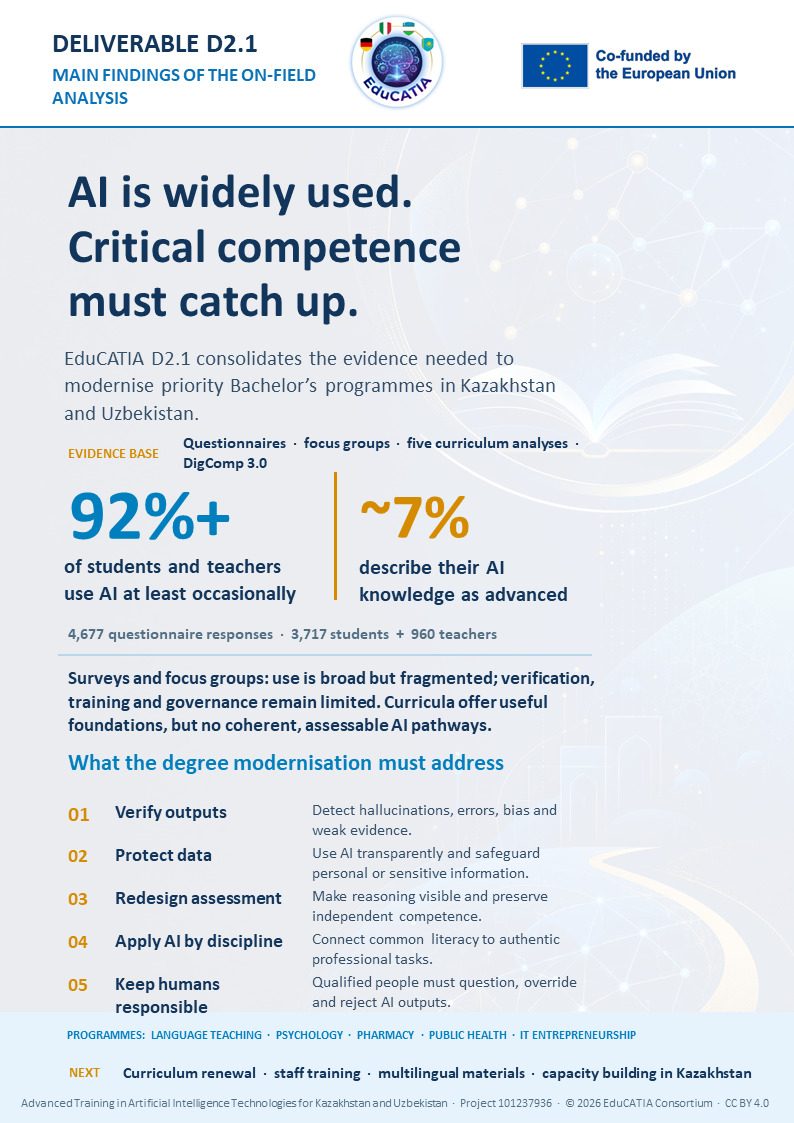
This report presents the consolidated findings of the EduCATIA analysis of AI-related educational gaps in higher education in Kazakhstan and Uzbekistan. It combines questionnaire responses from 3,717 students and 960 teachers, qualitative evidence from focus groups, curriculum analyses of selected Bachelor’s programmes, and a competence analysis based on the European DigComp 3.0 framework.
The findings show that artificial intelligence is already widely used across higher education: more than 92% of surveyed students and teachers reported using AI at least occasionally. However, widespread use has not yet developed into systematic, critical and professionally responsible competence. Only around 7% of respondents assessed their AI knowledge as advanced, while formal training and explicit curriculum integration remain limited. Students and teachers nevertheless expressed strong demand for further discipline-specific learning.
Across the evidence sources, the most urgent gaps concern verification of AI-generated information, detection of hallucinations and bias, protection of personal and sensitive data, transparent use, academic integrity and responsible human oversight. Focus-group participants also highlighted the need to redesign assessment so that AI-supported work remains transparent and students’ independent competence can be demonstrated. Although AI can support accessibility, translation, personalised learning, research and professional practice, these benefits depend on appropriate guidance, inclusive access and reliable safeguards.
The curriculum analyses cover Philology and Language Teaching, Psychology, Pharmacy, Medical and Preventive Medicine, and the additional institutional priority programme IT Entrepreneurship. Existing curricula provide useful foundations in ICT, statistics, research methods, data analysis or professional ethics, but generally lack coherent and assessable AI competence pathways. Specific priorities include AI-supported language education, ethically governed digital psychology, medication safety and pharmacovigilance, interpretable public-health analytics, and responsible development of AI-enabled products.
The report concludes that EduCATIA should focus not simply on increasing AI use, but on making it critical, explicit, assessable, inclusive and professionally accountable. Its findings will guide curriculum modernisation, staff capacity building, institutional governance and the development of multilingual educational materials. Future activities will translate shared principles into discipline-specific learning outcomes, teaching cases, verification protocols, assessment methods and supervised pilot activities across partner universities. Together, these measures will strengthen sustainable, responsible AI education across both countries and universities.
Please find the D2.1 report in English under the link: The Deliverable D2.1
UPDATE: the translations of the Deliverable 2.1 into Kazakh, Uzbek and Italian languages are uploaded to provide the experts and stakeholders on the regional level with materials in their native languages. Please find the links below:
D2_1_Report_of_the_on-field_analysis_final_IT
D2.1 Report of the on-field analysis_final_UZ
D2.1 Report of the on-field analysis final KZ

Co-Funded by the European Union. Views and opinions expressed are however those of the author(s) only and do not necessarily reflect those of the European Union. Neither the European Union nor the granting authority can be held responsible for them.